Canadian Federal Corporations: Filing Taxes Does Not Prevent Dissolution
- robertaccounting
- 2 days ago
- 8 min read

Updated: 3 hours ago
A federal corporation in Canada can have clean CRA filings, no tax debt, and a reliable accountant, yet still receive warning letters from Corporations Canada. In some cases, it can even face dissolution.
The reason is usually simple: the company has confused its Annual Return with its tax return.
For Canadian federal corporations, the Annual Return is not a T2 corporate income tax return. It is not a GST/HST return. It is not a financial statement. It is a separate corporate law filing submitted to Corporations Canada, generally tied to the corporation’s anniversary date rather than its tax filing deadline.
That distinction matters. Filing taxes with the Canada Revenue Agency keeps the company tax-compliant. Filing the Annual Return helps keep the corporation in good standing in the federal corporate registry.
This article provides general information only. It is not legal or tax advice. Specific questions should be confirmed with a corporate lawyer, accountant, or compliance service provider.

What the Annual Return is
The Annual Return is often called an annual filing or anniversary filing. For a Canadian federal corporation, it is a basic information confirmation filed each year with Corporations Canada.
Its purpose is to confirm or update key corporate registry information, such as:
Whether the corporation still exists and is operating
Whether the registered office address is current
Whether director information is accurate
Whether the corporation continues to meet federal corporate filing requirements
Whether the public registry should continue to show the corporation as active
The filing does not report income, expenses, profit, losses, or tax owing. Corporations Canada is concerned with the legal status and public record of the corporation, not the amount of money the business earned during the year.
A simple way to separate the two systems is this:
Annual Return | Tax return |
Filed with Corporations Canada | Filed with the CRA |
Focuses on corporate status and registry information | Focuses on income, expenses, taxes, and tax obligations |
A corporate law compliance filing | A tax compliance filing |
Usually tied to the corporation’s anniversary date | Tied to the tax year and tax filing deadlines |
Helps maintain the corporation’s active status | Helps meet income tax, GST/HST, payroll, and other tax obligations |
For federal corporations, the Annual Return is one of the basic steps in maintaining the corporation’s legal existence. Even if the corporation has no revenue, no employees, and no current business activity, it may still need to deal with this filing as long as it remains incorporated.
Why federal corporations must file it
When a federal corporation is created, it becomes part of the Corporations Canada registry. That registry records public information about the corporation and its status.
Banks, lenders, suppliers, customers, investors, government departments, and other parties may check that registry when they want to confirm that a corporation exists and remains in good standing.
The Annual Return keeps that system current.
If a corporation changes directors, moves its registered office, or stops using an old mailing address, the public record can quickly become outdated. Government notices may not reach the right person. Third parties may rely on stale information. Corporations Canada may not be able to tell whether the company is still active.
The Annual Return acts as a yearly confirmation.
It helps keep the corporation in good standing
A corporation that files its Annual Return on time is better positioned to maintain an active status in the federal registry.
That status can matter in practical situations. A bank may check it before opening an account or renewing a lending facility. A potential buyer may check it during due diligence. A supplier may check it before extending credit. A government department may check it before processing an application.
If the corporation’s status is not active, a routine transaction can become more difficult than expected.
It shows that the corporation is still maintaining itself
Incorporating is not a one-time task. The articles of incorporation create the corporation, but the corporation must still be maintained after that.
The Annual Return is one of the ways the federal system confirms that the corporation is still meeting its basic obligations. It tells Corporations Canada that the company has not simply been abandoned.
It reduces the risk of missed government notices
Many compliance problems begin with outdated contact information.
A director resigns. A registered office changes. A founder moves. A former address stops receiving mail. Then a government letter goes unanswered because no one sees it.
The Annual Return process gives the corporation a yearly reason to check whether its registry information still matches reality. That simple check can prevent bigger problems later.

Why filing taxes does not protect the corporation from dissolution
This is where many federal corporations get into trouble.
A corporation may have several government obligations in the same year, including:
Filing a T2 corporate income tax return with the CRA
Filing and paying GST/HST, if registered
Handling payroll deductions and T4 slips, if it has employees
Keeping accounting records and supporting documents
Filing the Annual Return with Corporations Canada
Maintaining corporate records, minutes, resolutions, and other internal documents where required
These tasks can appear related because they all involve government filings. They are not the same.
The CRA handles tax matters. Corporations Canada handles the federal corporate registry and corporate law compliance.
Filing with the CRA does not automatically file anything with Corporations Canada. If an accountant prepares and files the T2 return, that does not automatically mean the Annual Return has been filed, unless the accountant’s engagement clearly includes that service.
Filing taxes on time is not the same as completing the corporation’s annual corporate filing. CRA compliance does not replace Corporations Canada compliance.
Consider a common example.
A federal corporation files its T2 return every year. It has no CRA balance owing and no CRA penalties. The owner assumes everything is current because the accountant has handled the tax work.
A few years later, the corporation applies for financing. The lender checks the Corporations Canada registry and discovers that the corporation has not filed Annual Returns. The company may have received reminders, but they went to an old address. The corporation is no longer in the status the owner expected, or it may be at risk of dissolution.
From the owner’s perspective, this feels surprising. From the government’s perspective, two separate obligations were involved, and only one was being met.
When the Annual Return is usually due
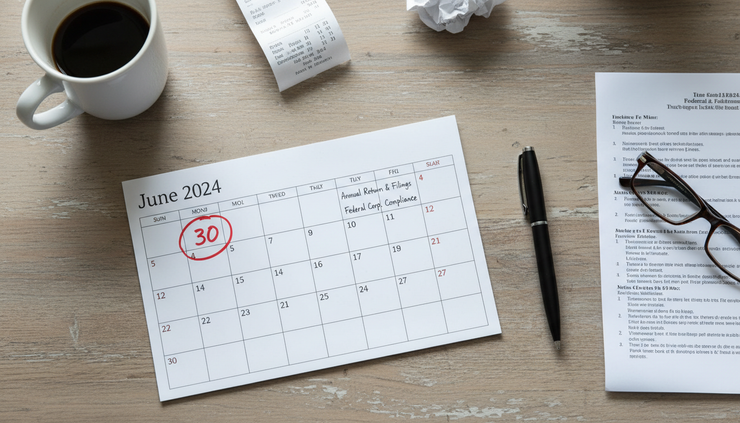
For Canadian federal corporations, the Annual Return is generally connected to the corporation’s anniversary date. That is the date the corporation was created, not the company’s fiscal year-end and not the CRA tax filing deadline.
In general terms, the federal Annual Return is filed each year around the anniversary period. Corporations Canada commonly expects the filing within a set period after that anniversary date.
This timing is one of the reasons the filing gets missed. Many business owners organize their compliance calendar around tax season. They think in terms of year-end bookkeeping, T2 deadlines, GST/HST reporting periods, payroll remittances, and accountant checklists.
The Annual Return runs on a different clock.
A corporation incorporated on 15 August may need to think about its Annual Return around that anniversary period, even if its fiscal year-end is 31 December and its tax filing work happens months later.
That separation is easy to overlook. It is also easy to fix once the corporation tracks both calendars.
What can happen if the Annual Return is missed
Missing one Annual Return may not cause immediate dissolution. The corporation may first receive reminders or notices. The exact path depends on the status of the corporation and the filings outstanding.
Still, ignoring the issue can become serious.
Corporations Canada has the power to take steps when a federal corporation does not meet its filing obligations. If Annual Returns remain outstanding, the corporation may eventually face administrative dissolution.
Dissolution means the corporation’s legal existence has been ended. That can create practical and legal problems.
A dissolved corporation may face issues such as:
Difficulty entering contracts
Problems with bank accounts or financing
Questions about ownership of assets
Trouble dealing with customers, suppliers, or government bodies
Extra work and cost to restore the corporation, if restoration is available and appropriate
If a corporation has already been dissolved, the next steps should be reviewed carefully. In some cases, revival may be possible. That process is separate from simply filing one late document, and it may involve legal, tax, and corporate record questions.
Why accountants do not always file the Annual Return
Many owners assume that if they have an accountant, all government filings are covered. That assumption can be risky.
Accountants commonly handle tax filings, bookkeeping, financial statements, GST/HST returns, payroll reporting, and related CRA matters. Some accounting firms also help with corporate filings, but not all do. Some will only handle the Annual Return if it is included in the engagement letter or requested separately.
The Annual Return sits closer to corporate maintenance than tax preparation. For that reason, it may be handled by:
The corporation’s owner or director
A corporate lawyer
A paralegal or corporate filings team, where permitted
A compliance service provider
An accountant, if the service agreement includes it
The safest approach is not to assume. Ask directly:
Who is responsible for filing the Annual Return?
Is it included in the annual accounting engagement?
What anniversary date is being tracked?
Who receives Corporations Canada reminders?
Who checks that the filing was accepted?
A short written confirmation can prevent a long cleanup later.
A simple compliance checklist for federal corporations
A federal corporation does not need a complicated system to avoid this problem. It needs a clear owner for each filing obligation and a calendar that separates tax deadlines from corporate registry deadlines.
Use this checklist as a starting point.
Confirm the corporation’s anniversary date
Find the incorporation date in the articles of incorporation or the Corporations Canada record. Add a yearly reminder before that date and another reminder shortly after it.
Do not rely only on CRA tax deadlines.
Check the public registry information
Review the corporation’s registered office address, director information, and status. If the public record is wrong, deal with it promptly.
Old addresses are one of the easiest ways to miss notices.
Confirm who files the Annual Return
If an accountant files it, confirm that in writing. If a lawyer or compliance provider handles it, keep their confirmation. If an owner or director files it internally, make sure more than one person knows the deadline.
A single-person memory system is fragile.
Keep proof of filing
After filing, save confirmation records with the corporation’s other documents. Keep them separate from tax returns so they do not get lost inside CRA-only records.
A basic corporate maintenance folder can include:
Articles of incorporation
Annual Return confirmations
Director and officer changes
Registered office changes
Resolutions and minutes
Shareholder and director records
Key government correspondence
Review tax and corporate obligations separately
A year-end checklist should have one section for CRA matters and another for Corporations Canada matters.
That split helps avoid the common mistake of treating “taxes filed” as “everything filed.”

The key takeaway
A Canadian federal corporation can file every tax return on time and still fall out of compliance with Corporations Canada.
The Annual Return is a separate filing. It confirms the corporation’s legal and registry information. It is usually tied to the corporation’s anniversary date, not the tax year. It should not be assumed to be part of CRA tax work unless someone has clearly agreed to handle it.
The practical next step is simple: check the corporation’s anniversary date, confirm who is responsible for the Annual Return, and make sure the filing history is current.
For federal corporations, good standing is maintained one year at a time. Taxes are only one part of that picture.



Comments