Owning Property in China After Moving to Canada: Key Canadian Tax Rules
- robertaccounting
- 2 days ago
- 9 min read

Updated: 3 hours ago
Many Chinese families arrive in Canada with more than one property already in China. One home may be the former family residence. Another may be a school-district apartment, a rental unit, or a property registered under a parent, spouse, or adult child.
Once the family starts buying in Canada, filing Canadian tax returns, and reporting overseas assets, the simple question of “where is the house?” becomes too narrow.
Canada’s tax system looks at tax residency, worldwide income, asset use, ownership, and reporting obligations. A property located in China can still matter for Canadian tax once the owner becomes a Canadian tax resident.
This article is general information only. It is not legal, tax, or investment advice. Cross-border planning should be reviewed with a licensed tax professional, CPA, real estate lawyer, or immigration-aware advisor who can look at the family’s landing date, ownership records, source of funds, rental use, and future sale plans.

Holding several homes before immigrating is common
For many families, multiple Chinese properties are not unusual. They often come from long-term savings, family arrangements, or a staged immigration plan.
In major Chinese cities, real estate has often served more than one purpose. A home may provide shelter, support retirement planning, preserve family wealth, or help with a child’s education. By the time immigration to Canada becomes realistic, the family may already hold a mix of personal-use and investment properties.
Ownership can also be more complex than the land registry suggests. A property may be registered under one spouse, while both spouses contributed money. A parent may be the legal owner, while an adult child manages the rent. A family member may live in the property rent-free, while another person pays the loan and maintenance.
For Canadian tax purposes, the key questions are not limited to who lives there. Advisors may ask:
Who is the legal owner?
Who is the beneficial owner?
Who paid for the property?
Who receives rental income?
Who pays the mortgage, property fees, repairs, and taxes?
Was the property bought for personal use, rental income, or future sale?
These details matter because Canadian reporting often follows the person who actually has the economic interest in the property.
A staged move can add another layer. One spouse may land in Canada first, while the other remains in China to sell or manage properties. Parents may stay behind in the original home. Some families sell one Chinese property to fund a Canadian purchase, while others keep assets in both countries.
The common mistake is assuming that “the property is still in China” means “Canada does not need to know.” Once Canadian tax residency begins, that assumption can create problems.
Canadian tax residency is the starting point
Canadian income tax does not depend only on citizenship or permanent resident status. A person can become a Canadian tax resident before becoming a citizen. A person can also have Canadian tax issues even if they have not spent a full calendar year in Canada.
The Canada Revenue Agency generally looks at residential ties. These can include:
A home available in Canada
A spouse or common-law partner in Canada
Children or dependants in Canada
Time spent in Canada
Canadian bank accounts, credit cards, driver’s licence, or health coverage
Personal property and social ties in Canada
The centre of daily life
Once a person becomes a Canadian tax resident, Canada generally taxes that person on worldwide income. That can include income from China, even if the money stays in a Chinese bank account.
For families with Chinese real estate, the most common items are:
Rental income from a Chinese property
Capital gains from selling a Chinese property
Interest from Chinese bank deposits
Income from overseas investments, funds, or securities
Income from foreign companies, partnerships, or trusts
The location of the cash does not control the answer. If a rental apartment in Shanghai produces rent that is deposited into a China-based account, the rental income may still need to be reported in Canada by the Canadian tax resident who owns or benefits from the property.
Tax treaties, foreign tax credits, and local Chinese tax rules may affect the final tax result. They do not remove the need to review and report the income properly.

Buying a home in Canada brings land transfer tax into the budget
After moving to Canada, many families focus on the down payment, mortgage pre-approval, interest rate, inspection, insurance, and legal fees. Land transfer tax can be missed until late in the process.
Land transfer tax is usually paid by the buyer on closing. It is not a single national tax. Provinces set their own rules, and some cities add their own charges.
For example, buying in Ontario usually means considering the provincial land transfer tax. Buying in Toronto may also involve a municipal land transfer tax. British Columbia has its own property transfer tax rules. Other provinces and municipalities use different systems, names, exemptions, and rebates.
The amount may depend on:
Purchase price
Province and municipality
Buyer’s residency and immigration status
Whether the buyer qualifies for a first-time home buyer rebate
Whether foreign buyer or non-resident rules apply
Property type and intended use
Two points matter especially for new immigrants.
First-time buyer relief is not automatic
Some provinces or municipalities offer rebates or reductions for first-time buyers. The rules can include residency requirements, age, occupancy, and prior ownership history.
A person who owned a home in China should not assume they qualify or fail to qualify based on casual advice. The answer depends on the exact provincial or municipal program and the wording of the forms. In some cases, a spouse’s prior ownership may also matter.
Before making an offer, ask the real estate lawyer to confirm whether Chinese property ownership affects the Canadian rebate claim. That should happen before closing, not after the budget is fixed.
Buyer status can change the total cost
Canada has introduced several restrictions and extra costs for non-Canadian buyers in recent years. The rules can vary across federal, provincial, and local systems. Permanent residents, citizens, temporary residents, work permit holders, international students, and non-resident buyers may face different treatment.
A buyer should confirm the applicable rules before waiving conditions or signing a firm agreement. If a non-resident or foreign buyer tax applies, the closing cost can be much higher than expected.
For cross-border families, the safest planning starts with one question: who exactly will be on title, and what is their status on the closing date?
Canadian income tax looks at worldwide income after residency begins
The title Canada Tax Rules for Chinese Immigrants Owning Multiple Homes often raises one big issue first: what happens to the Chinese homes after landing?
When a person becomes a Canadian tax resident, many capital assets are generally treated as if they were acquired at fair market value on that date for Canadian tax purposes. This is often called a cost basis or adjusted cost base reset for Canadian purposes.
For Chinese real estate, this means the value on the date Canadian tax residency begins can be very important. If the property is later sold, Canada may generally look at the gain that accrued after the person became a Canadian tax resident, using that entry value as the starting point.
Good records matter. Families should keep evidence such as:
Independent valuation reports
Recent comparable sales in the same building or neighbourhood
Appraisal letters from qualified local professionals
Purchase contracts and ownership certificates
Renovation invoices and major improvement records
Exchange rate records for relevant dates
Do not wait until the sale happens years later. It can be hard to reconstruct a reliable value long after landing.
Rental income also needs careful handling. Canadian reporting usually starts with gross rent, then allows reasonable expenses based on Canadian tax rules. Expenses may include items such as property management, repairs, mortgage interest, and maintenance fees, depending on the facts. Personal-use portions must be separated from rental-use portions.
Currency conversion is another issue. Canadian tax returns are filed in Canadian dollars. Income, expenses, purchase values, and sale proceeds from China usually need to be translated using reasonable exchange rates. The chosen method should be consistent and supported.
Foreign asset reporting is about forms, not only tax owing
One of the easiest areas to overlook is foreign asset information reporting. Many people ask whether they owe tax. They forget to ask whether they must file a form.
Canadian tax residents who hold specified foreign property with a total cost amount above the reporting threshold, commonly more than CAD $100,000, may need to file form `T1135`. This is an information return. It can apply even when little or no Canadian tax is payable.
The exact result depends on the type of property and how it is used.

Owning a property can trigger reporting even before selling
Some overseas assets may need to be reported simply because they are held. A sale is not the trigger for every reporting obligation.
If a Chinese apartment is held mainly for investment or rental income, it may be specified foreign property for `T1135` purposes. If several overseas assets are held, their combined cost amount may push the owner over the threshold.
Penalties for missed information returns can be significant, so the form should not be treated as a minor detail.
Personal-use property is different from rental property
A home in China used only by the owner or close family for personal living may be treated differently from a rental or investment property. The distinction can be fact-specific.
Problems arise when a property shifts use. For example, a former family residence may become a rental after the family moves to Canada. A parent may live in one room while another part is rented out. A vacant unit may be listed for rent but also used during visits.
The use pattern should be documented. Keep lease agreements, rent receipts, utility records, and notes about personal occupancy.
Legal ownership and beneficial ownership may not match
Canadian tax filings may look beyond the name on title. If a property is registered under a parent’s name but the Canadian resident paid for it, receives the rent, and controls sale decisions, the tax analysis can become more complex.
The same concern applies when a spouse, adult child, or relative is listed as owner for convenience. Informal family arrangements may work socially, but they can create uncertainty for Canadian reporting.
Before filing, the family should map out both legal and beneficial ownership. That map should match bank records, contracts, family agreements, and tax filings as much as possible.
Selling a Chinese property after moving to Canada needs planning
Selling a Chinese property can bring several Canadian questions at once.
The first question is the property’s Canadian tax cost. For many immigrants, the fair market value on the date they became Canadian tax residents is a key starting point. The second question is the sale price and selling costs. The third is whether Chinese taxes paid on the sale may support a foreign tax credit in Canada.
Timing matters. A sale before Canadian tax residency may produce a different Canadian result than a sale after residency begins. That does not mean families should rush or delay a sale for tax reasons alone. It means the tax effect should be reviewed before signing a sale agreement.
Money movement is separate from tax reporting. Transferring sale proceeds from China to Canada can require banking, foreign exchange, and source-of-funds documentation. Canadian banks may ask for proof of sale, tax payment, ownership, and the history of funds. These are compliance questions, not just tax questions.
A clean file usually includes:
Original purchase documents
Proof of ownership
Valuation at Canadian residency start date
Sale contract
Proof of tax paid in China
Bank transfer records
Currency exchange records
Renovation and major repair receipts
A property sale often funds a Canadian home purchase, so the timing of sale proceeds and Canadian closing funds should be coordinated early.
A practical checklist before filing or buying
Cross-border real estate planning works best when the facts are gathered before tax season or a closing date.
Start with a property list. Include every home, rental unit, parking space, commercial unit, and land interest in China or elsewhere outside Canada. For each item, record the owner on title, purchase date, purchase price, current use, rental status, estimated value at landing, mortgage, and who receives income.
Then review Canadian residency dates. A family may not all become Canadian tax residents on the same day. One spouse may land months earlier. Children may start school in Canada while a parent remains abroad. These differences can affect reporting.
Next, classify each asset. Separate personal-use homes, rental properties, investment properties, bank accounts, securities, private company interests, and trust or nominee arrangements.
Then speak with the right professionals. A Canadian CPA can review income tax and `T1135` reporting. A real estate lawyer can confirm land transfer tax, buyer status, and closing rules. A lawyer with cross-border experience can help where ownership and beneficial interest are unclear.
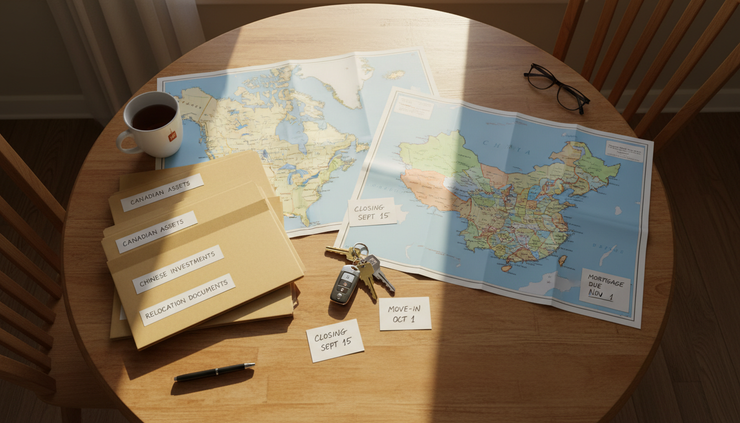
Canadian tax does not ignore a property because it is overseas. For Chinese immigrants with multiple homes, the main task is to connect each property to the right owner, use, income stream, date, and filing obligation.
The best next step is simple: build the full property file before buying in Canada, selling in China, or filing the first Canadian tax return. A few organized records now can prevent expensive confusion later.


Comments